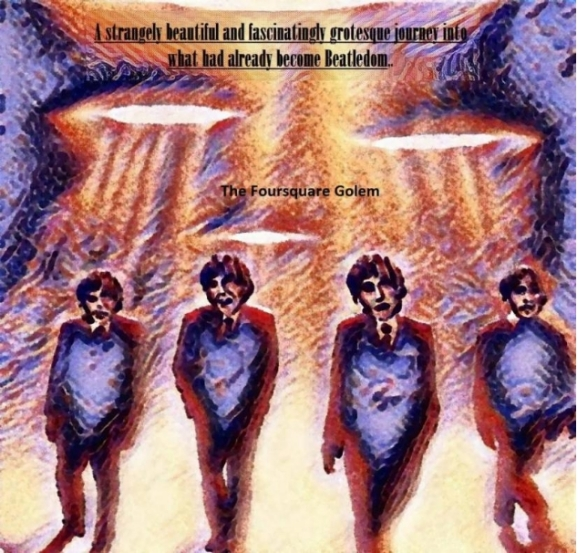
The Lennon-McCartney secret code and the hidden clues and ‘in-jokes’ in various Beatles songs.
Excerpt from the book - The Beatles and their Journey into Beatledom.

Email us by clicking on The Beatles here-------->
At Beatlesbooks.net, we believe The Beatles were more than just a band; they were conduits of profound wisdom. Our mission is to illuminate the hidden esoteric meanings in many of their most significant songs, offering fresh perspectives and deeper understanding for fans and truth-seekers alike.
We delve into symbolism, mythology, and ancient traditions to reveal how these elements resonate within The Beatles' lyrics and melodies. This website is a culmination of years of dedicated research and a passion for showcasing the unique genius of John, Paul, George, and Ringo.
Four words and last words. By Léo Copstèreles.
At times poetic, at times archly subliminal and secretively strange, The Beatles were and are fantastical and magnificent, harbingers and apocalypticos; - these are four words that go together very well! Fantastical in the sense that if their story was a fabula, a piece of fiction, no-one would believe it! But it is fabulous, - beyond belief. Mythic in its scope, heady in its heights, unfathomable in its shadowy depths and strangely weird in its quantum wondrousness. Ahh souvenirs!
Magnificent in the sense that their mythos was the most significant cultural event of the second half of the 20th Century, the fulcrum on which the century’s populism gathered pace and turned, and like the fated planets of astrology, their myth infused legacy too, is still turning.
Harbingers because as they peered into the future, that Journey Into Beatledom, they prefigured and prophesised about it in their belle chansons and public proclamations. Liberté, Égalité, Fraternité.
A cultural and consumerist revolution that by 1968 in America, the UK, France and elsewhere in the West, was to be breath-taking in its inveigle-like influences and stealth like effects.
As we have seen above, this transformation of the music industry and popular culture, whilst driven by The Beatles music, was also driven by the fans and the cultural context of the time; what French post-structuralist Roland Barthes called ‘The Death of the Author’.
In the context of Beatlemania, this could mean that fans' interpretations of the Beatles' music and lyrics, even if not intended by the band, are valid and contribute to the overall cultural impact of their music.
The Beatles were in all truth, the first global villagers, able to peer over the horizon and see into that still hazy future. Not only that, it has also been asserted that they were prophets, capable of an intuitive foresight because of their position at the apex of and as the focus of the new ‘sixties obsession with progressive change. [1]
They were also in a way, (metaphorically speaking), akin to the four horsemen of the Apocalypse. Monstrously gargantuan and
revelatory oracles of change able to somehow peer into the future. As they looked beyond the 1967 summer of love towards the 1968 summer of blood and political and celebrity assassinations, it was the latter which was weirdly (and tragically) connected to some of their White Album songs.
They were able too to slip behind the heavy curtained veil of cronyism, secrecy and hypocrisy of the old school entertainment world, (and as Joe Robiinson has already said), The Beatles originally had a foot in both the old show-biz world and the new Rock scene, before casting off their show biz antecedents as quickly as they could.
By revealing and surreptitiously uncovering through their pantheon of joyfully exuberant ‘sixties pop, a sleight of hand doomsday where nothing is real, they gazed towards a kaleidoscopic, holographic, quantum illusion of technological and civil progress in the guise of a libertarian, free market, but one now increasingly under the thumb of the elite bankers and their oppressive, regressive vision of a corporatist, new world order.
Headlining the British invasion of the States, The Beatles knocked Elvis clean off his perch at the summit of rock ‘n’ roll forever, before initiating the ‘67 summer of amour and predicting the following summer of strife in ‘68, when the season of love turned into the river of blood.
And Presley, that magnificent, hip thrusting, brooding King of the walk, could only ever have been dethroned by these four young emperors of the streets.
Of course, Elvis had an alluringly potent, albeit simple, countrified dignity early on, founded on his poor, working class roots and undoubted, shimmering sexual chemistry which blazed and bedazzled for a time until in 1977, his own massive fame (and massive frame), sadly snuffed the last glimmers of it out.
Though ‘The King’ eventually blotted his own copy book and cosied up to the corrupt, discredited Nixon administration of the early ‘seventies by denouncing the lads from Liverpool, [2] this was not because they themselves had forgotten their own unpretentious roots.
The Liverpool of the youthful Lennon’s childhood was (and still is as I have come to see for myself), the essential good time, party City, so very different from the well-heeled, smug complacency and compliance of the largely Royalist, mainly rural, Tory voting shires of Southern England and the bluff, gruff, taciturn stoicism of much of the English North.
Lots of old- time Liverpudlians of whatever class, seemed more than able to deal with these ups and downs through a staunch belief in themselves, their families and their communities, allied to a strong sense of civic pride in their city and a quick witted, quirky sense of humour.
Yet since the early 1980’s, the place has seen very rough economic times and much industrial strife, and sensitivities to criticism from outside has also seen more locals close ranks and go on the defensive.
The mass unemployment of the Thatcher era only re-emphasised the rampant emigration out of the Merseyside region, an exodus which had actually begun in the early thirties, the local inner city population having halved in size by the early ‘noughties from its pre-war high.
This no doubt knocked the city’s confidence somewhat, reduced the local Council’s budget as business rate payments declined, and the place and its inhabitants soon gained a reputation throughout large swathes of England from the mid 1980’s onwards for its political and industrial militancy, criminality and a supposedly self-inflicted, self-absorbed, ‘victim mentality’ and welfare dependent culture. That Liverpudlians became misunderstood by many other English people as outsiders, who often saw them as zealously over-sensitive, bolshie and insular, was largely the result of lazy stereotyping and blind, bigoted ignorance about work shy scousers, the majority of critics having never even set foot in the North West of England, let alone urban Liverpool.
However, those who have either visited the City or actually settled there are often pleasantly surprised by the warmth of their welcome, and the fact the area has lower crime rates than both Manchester and many areas of London.
The Toxteth Riots of 1981, (like the Brixton Riots of the same year), had causes which were far more complex and troublingly complicated. Though no doubt, open police racism in the form of an aggressive stop and search policy for young black men, wider racial and class discrimination in the form of a lack of employment opportunities for young black and Asian ethnic groups and young, poor whites, were all compounded by Liverpool’s generally sharp economic decline, a decline the Thatcher Government first tacitly then explicitly encouraged. [3]
By then of course, The Beatles had come and gone. But what they had taken with them from both their Hamburg friends and the City of Liverpool to London and elsewhere, was to become absolutely essential to the initial development of their overall, existential, golemic and foursquare mind set. A mindset akin to and comparable to many features of the eastern religious traditions soon to influence the nascent counterculture. [4]
For example, in Buddhism, this mindset encompasses a universality that is ‘a symbiotic order in which humanity, nature, and the cosmos coexist, and microcosm and macrocosm are fused in a single living entity…Whether in human society or in the realm of nature, nothing exists in isolation; all phenomena are mutually supportive and related, forming a living cosmos. Once this is understood, then we can establish the proper role of reason.’ [5] This reasoning and mind set was also skilfully complemented by their theatrical manager Brian Epstein’s flair for showcasing and dressing The Beatles in a style which gave them an unusual almost mysterious quality.
Their former indisciplined savage appeal was now counter-balanced by an engaging, coiffured self-assurance, intelligent poise and feminised, early version of post-modern metro-sexuality, which wrong footed their audience, who, in a state of perplexed, disorientated sexual excitement themselves, could much more easily relinquish control and give into the infectious mania of their peers. [6] This seething amalgam of opposites gave The Beatles an edge which scythed through fans preconceptions of what male pop stars should behave like.
And just like many of their working class ‘Scouse’, Liverpudlian compatriots, The Beatles, alongside a significant number of the more well to do locals who lived in the suburbs, still exhibited a recognisably comparable mixture of wry, absurd, almost gentle frivolity and sometimes roughhouse disdain for the disingenuous
bullshit of the ruling classes, their distrust being somehow both sharp and blunt at the same time.
John Lennon’s heroism (and that is what it was), was to question and kick back against the oppressive, stifling snobbery of class based deference the lower classes were expected to accept. A hero of the working classes if not a typical working class hero.
Elvis was a very poor man made good. But in the final analysis, he was no outright champion of the working man. An icon yes. A firebrand? Definitely not.
This book and its author have, within these pages, produced a hagiography, albeit a critical one and definitely the poetic hagiography The Beatles deserve. That is okay as far as it goes, as long as we do not forget that all saints were once sinners, and The Beatles often seemed honest enough to admit to their sins, as we have seen! As I’ve already said, they may have been prophets, but they were of course, all too human.
Yet, when the young, proto-Fabs engaged with the pan-European, existentialist and permissive oeuvre via their Hamburg circle of leather clad friends, their emerging style was in fact more French than German.
Parisians have a word for this kind of de rigeur stance too and it is chic. One has only to glance at the cover photograph of their 2nd album With The Beatles to understand why these four young musicians from Liverpool were seen as not only fashionable, stylish and super-cool but mysteriously yet unselfconsciously hip and even sexually ambivalent in a way very few white musicians had ever even considered, but which many black, American musicians before them (male and female), would instantly recognise. [7]
The Beatles had all four attributes in abundance, recognising themselves, perhaps inimically, that their anti-authoritarian stance and Celtic roots might flourish and bear once forbidden fruit
amongst the chic, and metropolitan Parisi. [8]
The Beatles were also Janusian thinkers, (the left handed-right handed - melodic-harmonic mirroring of McCartney and Lennon being an apt example), - what I would describe as a gelf-like paradox [9] of chameleonic proportions, and as such, when they donned their stylish Pierre Cardin suits they were able to lull the old
guard high fashionistas into a false sense of security.
Simply put, when that old guard let their guard down, the foursome high-jacked the fashion agenda and then promptly changed it, their subsequent stylistic reincarnations sounding the death knell of haute couture for decades to come.
Now that their callow artlessness was to be so subtly but surely transmogrified into a strange brew of mercurial wisdom and cool farsightedness, it was not to be too long before the high fashion of the Parisian boulevards, so beloved of the post-war, monied classes and aped by the middle classes, was to be replaced by the low fashion of the streets.
Yet for the time being, proto-peacenik Lennon could still marvel at the ordinary Parisian’s propensity for kissing, canoodling and holding hands in public when he visited the French Capital with Beatle buddy Paul in October 1961. [10]
All you need is lurve or I want to hold your hand, just take your pick! Les Marseillaise was as alive on the banks of the Merci Beaucoup as ever it was on the banks of the Seine. Now Liverpool is not chic, but it is de rigueur, - (de gear in Liverpool). Like Paris, which had Le Caveau de la Huchette, Liverpool had The Cavern. [11]
Merseyside once even had its own version of Le Tour Eiffel, and even after the New Brighton Tower itself was demolished, The Beatles still performed at the ballroom venue below the demolished tower on more than a score of occasions at the likes of Sam Leach’s Operation Big Beat, with an estimated attendance of three thousand or more and certainly their biggest to that date. [12] And the port of Liverpool, facing the sea and with its back to the rest of England is, like Paris, parochial, insular, stubborn, the contrary Capital of itself. [13] Over fifty years later and it still is. A case of ‘eh la” instead of ‘ooh la la!’
It was in the Paris of 1961 too that the Beatles ‘Bob’ haircut was born amid ethnic civil unrest as many Algerian nationalists cum political freedom fighters fought and died, their protest marches turning into a deadly battle with the Parisian authorities. A case of French bangs not Algerian bombs. [14]
And though John and Paul did not get much chance to cherchez la Femme (the Parisian Mademoiselles being curiously immune to their teddy boy charms), [15] they’d already had plenty of previous experience in that department in both Hamburg, Germany as well as in their hometown of Liverpool. To the local Brigittes, the two young, leather clad Beatle-teds were an acquired taste.
Fast forward to very early 1964 at the Olympia Theatre on 28 Boulevard Capuchines, and it was very much the same story at their first concert, with a retinue of chaperoned girls constituting a rather subdued congregation and a crowd of slightly effeminate looking boys from the Left Bank, making most of the noise and lapping up those long haired, head shaking beatniks from the Banks of the Mersey. Gay Paree indeed. [16]
In Europe, The Beatles quickly became known as the ‘yeah, yeahs’, a refrain they had probably unconsciously borrowed from the Parisian r ‘n’ b and rock ‘n’ roll scene of 1961 with former Ye Ye girl Sylvie Vartan appearing on the same bill as them during their Olympia Theatre concerts. [17]
By the end of their eighteen day Olympian stint, Beatlemania reigned in the French Capital as it had elsewhere, as armed Parisian Gendarmes surrounded the venue and the foursome were forced to leave the stage amid chaotic scenes. So what had changed?
The Beatles’ performances and personalities were still mesmerising. Both the chaperoned girls and exi-boys came to see what the fuss was all about and quickly realised, (along with those young, ticketless fans outside the theatre and The Beatles’ hotel), that this was a head shaking, convention-breaking phenomenon that they could not deny.
This despite the stern presence of the highbrow, Parisian old guard in the form of parents, grandparents or other adults tasked with protecting them from the sexual undercurrents of a highly
infectious mania the rest of the western world and beyond was soon to catch too on an absolutely epidemic scale, not seen anywhere else in the world before or since.
The invigorating winds of peace and love were soon to be on the air and in the air as both the young, and even large sections of the adult population, closed their eyes and took in large, refreshing gulps. But this was much more than a breath of fresh air. It was a super-oxygenated, head spinning, life enhancing lungful.
Today, 21st century onlookers might point to the West’s disastrous, confused and confusing foreign policy in Afghanistan, Iraq, Libya, Syria, Somalia, Yemen and the rest, and the current ‘war on terror’ in the wake of 9/11, as well as the tensions between Russia and the West over Ukraine.
Maybe there are those who reckon that The Beatles and their love advocating messages are now redundant in a world riven by sectarian and religious conflict. They really need to think again. They couldn’t be more wrong. In fact, the very opposite is true.
It was very interesting to note that the Parisian crowd’s recent and defiant rendition of Lennon’s Imagine drew widespread applause at the Marche Republicaine in the wake of the horrific Charlie Hebdo related terror attacks in early 2015.
In the same week, Give Peace A Chance continued to be the anthem of choice of the oppressed as witnessed in response to Boko Haram amid Nigerian unrest and bloody death. [18]
Putting that musical legacy to one side, (as there is broad agreement on its obvious merits and continuing longevity), the cultural impact of The Beatles’ message of peace and love is as relevant today as ever it was and that if nothing else, deserves the respect and gratitude of a seemingly broken world.
Paul McCartney, in a recent audience before the student fraternity at Rollins College admitted he himself still hadn’t a clue how the creative process filtered through to him and his bandmates. [19].
Like I’ve just reiterated, the cultural impact of many of their major songs, gives The Beatles’ songbook a neo-political cache like no other collection of hits. Their often implicit (and intelligent) cerebrality bled into the cultural ether that surrounded it.
Demonstrating that here has been another major aim of this book. If the mind is a mystical region, then Beatledom is a psychic, secluded realm situated somewhere between those mysterious cultural and cerebral zones, where battles are fought, ideas debated and arguments won. It is a place beyond. Beyond belief but somehow strangely real.
The pen indeed is a mighty sword, painting pictures, speaking words of wisdom and leaving clues. All we have to do is look in the right places and the author’s search here delves into the most mysterious and hidden corners of Beatledom itself.
The phenomenon of Beatlemania then can be seen as one involving complex interactions between The Beatles themselves, the media, and their fans/audience within a specific historical context of social change and technological development. This was a development in which the mass media's emergence in the 1960s' involved the questioning of traditional social structures.
This post-structuralist lens can be seen to re-interpret the Beatles' music and lyrics by contemporary fans and subsequent generations, demonstrating how cultural phenomena are constantly deconstructed and reconstructed through their dissemination and adaptation over time, rather than existing as fixed, singular entities.
At its most effective, The Beatle golem was always at its best when in a state of perpetual flux, the pace of change as demonstrated by their impatience and rapid artistic development simply reinforcing their constant desire to innovate.
We French have a saying, an existential epithet. It is the journey that counts, not the destination. When you realise this fundamental truth, you can learn how to play the game of both life and love and then maybe, just maybe, you will find your own way through the maze of possibilities that confront us all as you take your own special Journey Into Beatledom.
Léo Copstèreles. (Nom de plume de Seth L’eteba), July 2022.
Otherwise known as Josh P. Senborino.
1 Jul 2026 12:09
Excerpt from the book - The Beatles and their Journey into Beatledom.

22 Jun 2026 20:12
The Beatles - weird, wonderful, wacky and way out.
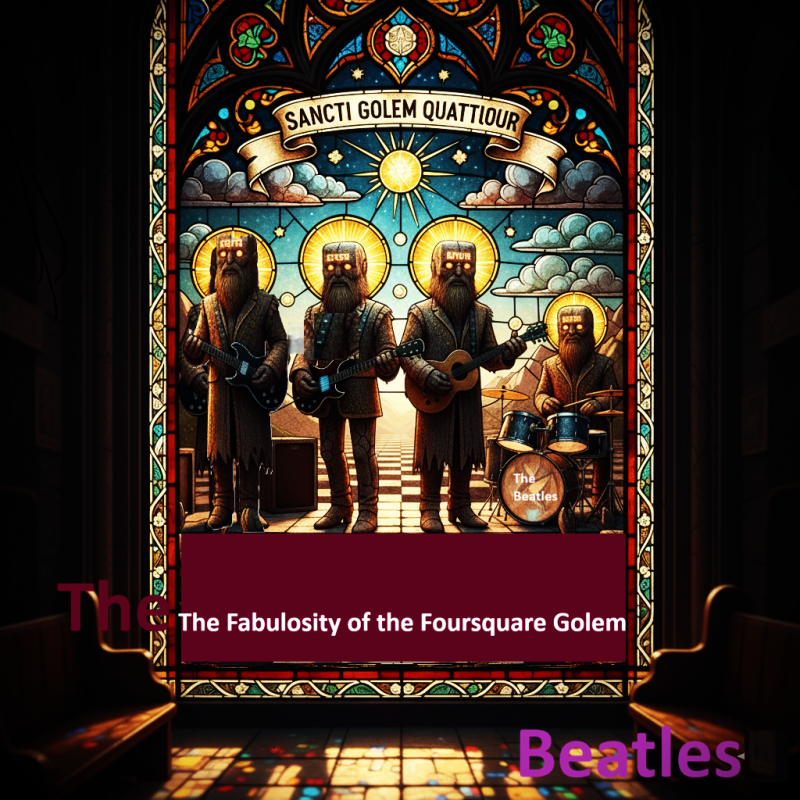
The Fabulosity of the Foursquare Golem - The Beatles, shaped and moulded by their Jewish manager Brian Epstein, became this manic, cultural monster - THE FOURSQUARE GOLEM.
See our extensive collection of resources, from detailed song analyses to comprehensive glossaries of esoteric terms, is designed to enrich your understanding and appreciation of The Beatles' mystical journey. Start your exploration today.
Create Your Own Website With Webador